Meow Metrics and the Emergence of a New GovTech Category: Intelligent Community Cat Management
For years, community cat management in Spain depended almost entirely on Excel spreadsheets, WhatsApp groups, and the extraordinary dedication of volunteers. Today, however, a new reality is beginning to emerge: the digital transformation of community cat management through specialized technological platforms such as Meow Metrics.
The growing public and institutional attention surrounding tools designed to help municipalities manage community cats confirms something important:
ethical and efficient community cat management is no longer only an animal welfare issue.
It is also a matter of:
- public health;
- governance;
- Smart Cities;
- urban sustainability;
- and digital transformation within public administration.
Law 7/2023 and the New Challenge for Municipalities
Since the implementation of Ley 7/2023 de bienestar animal (Spain’s Animal Welfare Act), municipalities have a legal obligation to:
- implement TNR (Trap-Neuter-Return) programs;
- maintain updated community cat colony censuses;
- and coordinate with local volunteer networks.
The challenge is that many municipalities still lack:
- specialized personnel;
- digital infrastructure;
- traceability systems;
- and the technical capacity required to organize and centralize all related information.
In many cases, community cat management still depends on scattered emails, phone calls, and disconnected documents, making it extremely difficult to:
- control colony populations;
- ensure veterinary follow-up;
- justify public funding;
- and make evidence-based decisions.
This is precisely where GovTech technology applied to animal welfare begins to play a transformative role.
What Is Meow Metrics?
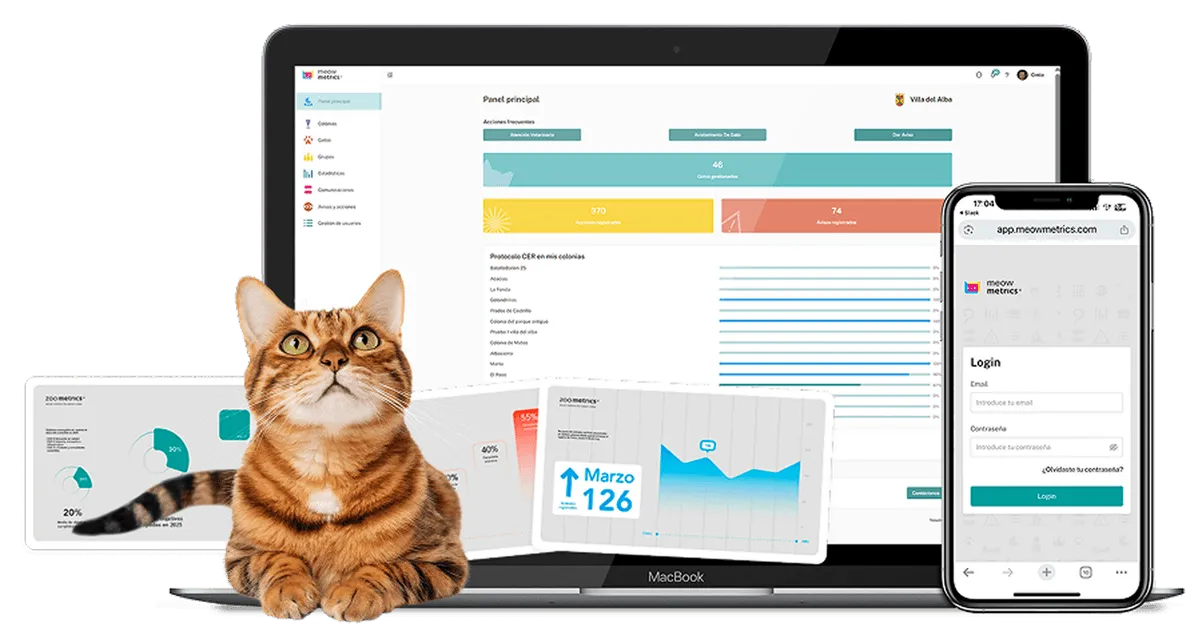
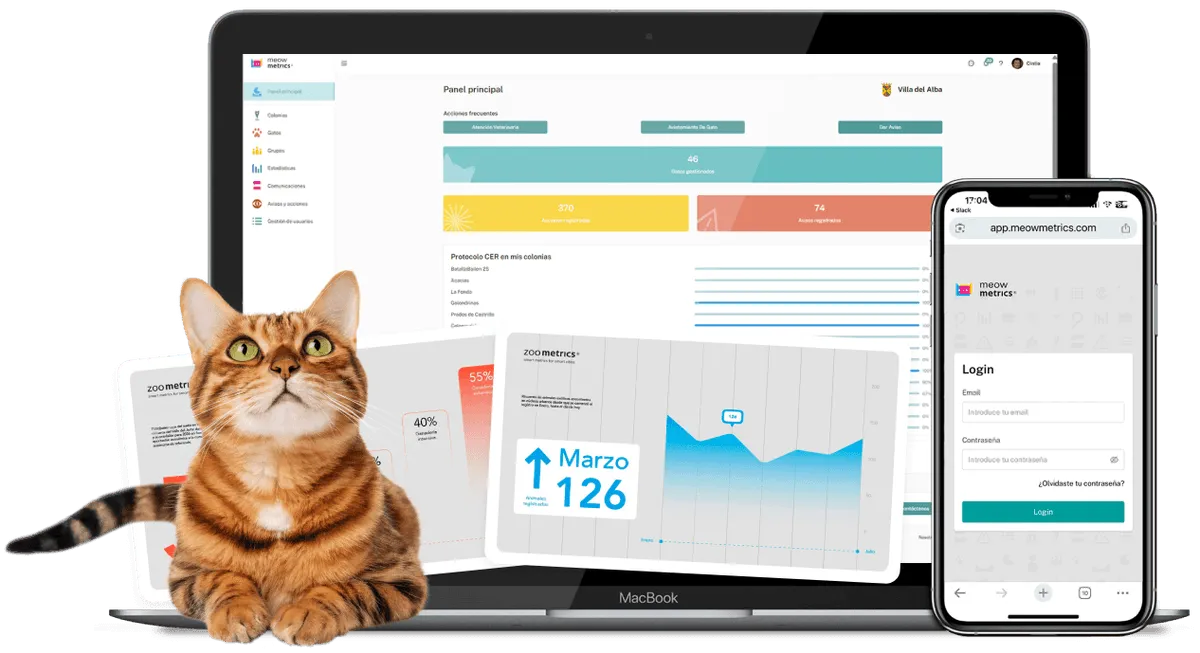
Meow Metrics is a SaaS digital platform specifically designed for intelligent community cat management and collaboration between municipalities, veterinarians, and volunteer colony caregivers.
The platform allows users to:
- geolocate community cat colonies;
- register individual cats;
- monitor sterilizations and veterinary treatments;
- generate automatic reports;
- record incidents;
- and centralize all information related to municipal TNR programs.
However, the platform’s true value extends far beyond simply registering cats.
Meow Metrics functions as a public digital infrastructure capable of transforming fragmented information into actionable intelligence for municipal management.
From Reactive Management to Data-Driven Planning
One of the biggest historical challenges in community cat management has always been the lack of reliable data.
Without data, municipalities cannot:
- plan resources efficiently;
- justify budgets;
- measure results;
- or identify patterns related to abandonment and reproduction.
Digitalization completely changes this paradigm.
Through data analytics and georeferencing technologies, municipalities can now:
- visualize colony and incident maps;
- anticipate emerging problems;
- identify critical areas;
- and optimize TNR campaigns.
At the same time, veterinary traceability contributes directly to the One Health approach, connecting:
- animal welfare;
- public health;
- and urban sustainability.
A New Category Within the Smart City Ecosystem
Traditionally, Smart City discussions have focused on:
- mobility;
- traffic management;
- street lighting;
- waste systems;
- and energy efficiency.
However, urban biodiversity is rapidly becoming a new strategic dimension of intelligent city management.
Meow Metrics is part of this evolution.
The platform connects:
- animal welfare;
- public governance;
- citizen participation;
- data science;
- and administrative digitalization.
This opens the door to an emerging GovTech category:
Urban Biodiversity Intelligence
In other words, digital tools capable of transforming urban biodiversity into a measurable, governable, and strategically manageable dimension of municipal policy.
The Role of Volunteers in Digital Transformation
One of the most innovative aspects of Meow Metrics is that it places colony caregivers at the center of the system.
For decades, thousands of volunteers have sustained feline population control almost entirely on their own by:
- feeding colonies;
- coordinating sterilizations;
- caring for sick cats;
- and resolving incidents.
Yet most of this knowledge and operational experience was never formally recorded.
The platform transforms that daily expertise into structured and useful public data.
This allows municipalities to:
- officially recognize volunteer work;
- improve coordination with colony caregivers;
- and professionalize management systems without losing the essential human dimension behind animal welfare work.
The objective is not to replace volunteers.
It is to transform them into strategic partners within public administration.
Spain as an International Reference in Community Cat Management
Spain is increasingly positioning itself as one of the most advanced countries in the world regarding ethical community cat management and legislation.
The combination of:
- Law 7/2023;
- municipal TNR programs;
- specialized volunteer networks;
- and technological innovation;
is attracting growing international interest.
In this context, Meow Metrics has already achieved:
- operational presence in Spain;
- implementations in the United States;
- and projects in the Middle East.
This demonstrates that intelligent urban wildlife management is no longer a marginal niche.
It is becoming an emerging market within the GovTech and Smart City ecosystem.
The Future: Artificial Intelligence and Urban Biodiversity
The natural evolution of platforms such as Meow Metrics points toward:
- artificial intelligence;
- and predictive analytics.
The objective is to help cities:
- anticipate conflicts;
- prevent public health risks;
- optimize public resources;
- and make evidence-based decisions.
Because community cat management is not only an animal welfare issue.
It is also a matter of:
- urban coexistence;
- public health;
- urban planning;
- and intelligent governance.
Conclusion
Community cat management is no longer an invisible issue handled through improvised systems.
The combination of legislation, digital transformation, and citizen collaboration is creating a completely new model of local public policy.
Platforms such as Meow Metrics demonstrate that technology can:
- reduce conflicts;
- improve coordination;
- professionalize volunteer management;
- and help municipalities comply efficiently with their legal obligations.
But perhaps most importantly, they demonstrate something even bigger:
the cities of the future will also need to learn how to manage urban biodiversity through data, intelligence, and collaboration.
https://www.humaneworld.org/en/resources/help-community-cats-tnr-program