Volunteers have spent decades paying out of their own pockets for a responsibility that was never theirs. Food, sterilizations, hours and hours looking after colonies that, legally, were never their obligation.
In 2023 a law came into force that finally recognizes it: managing cat colonies is the responsibility of municipalities. And we reach 2026 with a lot of homework still pending.
The frustration of volunteers and associations is understandable. Many are still waiting. Many have a strained relationship with their local government. On Sunday 6 September, at 12:00, that frustration takes to the streets: dozens of Spanish cities host demonstrations and rallies called by the platform Los Gatos Tienen Ley, calling for the effective enforcement of Ley 7/2023 de bienestar animal (Spain’s Animal Welfare Act).
It is also worth looking at the other side. Many municipalities experience this law as one more obligation that came out of the blue: with no dedicated staff, no clear budget, and a relationship with local volunteers that is not always easy after years of misunderstandings.
This article is not about finding someone to blame. It is about solutions. And there is good news: a great many municipalities are catching up right now. Drafting their first TNR (Trap-Neuter-Return) program. Updating bylaws. Carrying out censuses. Accrediting their volunteers. Many are even providing cat food.
It is a real challenge, and there are many parties involved. That is why we want to help all of them: municipalities, to comply with the law without it becoming an impossible burden. Volunteers and colony caregivers, to organize themselves and work side by side with their administration. Associations and companies that run municipal TNR programs, to professionalize their service. And specialized consultants, to serve more municipalities without multiplying their workload.
Let us first look at what the law says, and then at how to make it possible in practice.
What does Law 7/2023 say about cat colonies?
Spain’s Law 7/2023, on the protection of animal rights and welfare, gives municipalities the responsibility to manage urban cat colonies ethically. In practice, this translates into several specific obligations:
· Registration and census of the colonies in the municipality.
· Identification of the animals by microchip.
· Sterilization of the cat population using the TNR method.
· Continuous veterinary monitoring of the colonies.
· Collaboration with the people and organizations already looking after these animals on the ground, without that collaboration replacing public responsibility.
These are not conceptually new obligations —many municipalities were already working with TNR programs before 2023—, but the law turns them into a formal responsibility, with the need to be able to prove them: in audits, for regional grants, and to the public itself.
Why, day to day, complying costs more than it seems
The difficulty is not usually a lack of will, but logistics. A well-managed TNR program depends on several actors working in coordination —municipal officers, associations and volunteers, veterinarians, companies contracted for the TNR service— and on that information being kept up to date and accessible to everyone.
In most municipalities, that coordination still relies on Excel sheets, Word documents and communication by WhatsApp or email. It works, until you have to show the municipal comptroller (Intervención) how many cats have been sterilized this year, answer a citizen’s query with up-to-date data, or prepare the annual report of a program that has been running “by hand” for two years. And that is where the lack of a common tool starts to weigh, both on the municipal officer and on the volunteers who pass on the information.
How we help each party fulfill its role
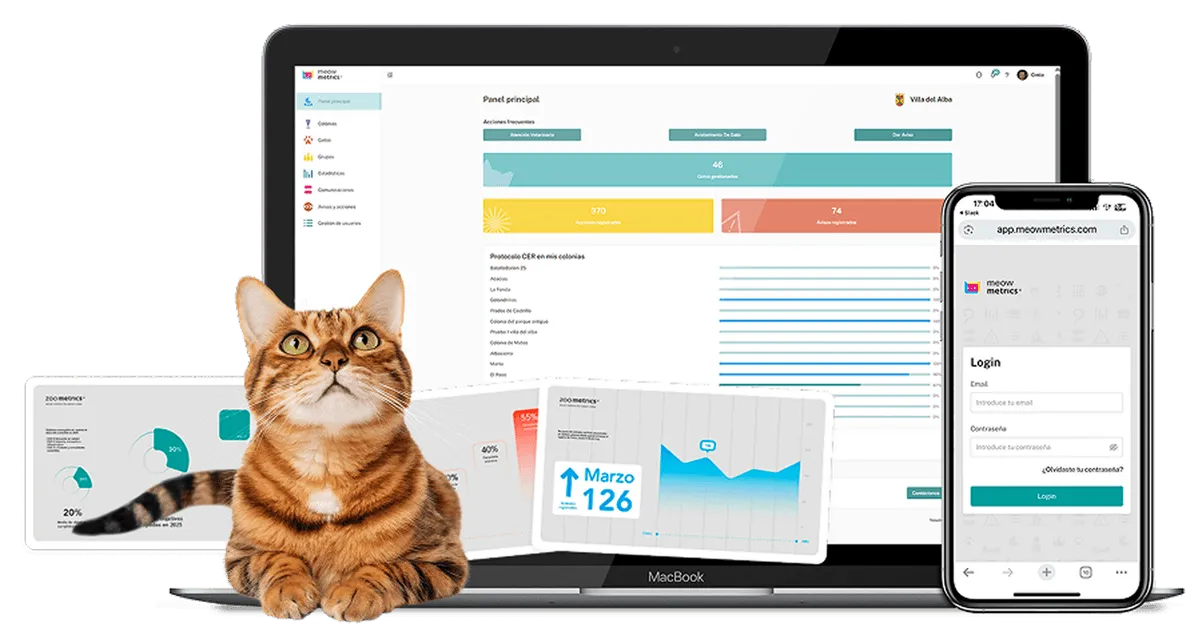
At Meow Metrics we believe technology does not replace anyone: it connects those who are already doing the work, so that the work turns into useful data and less friction between everyone.
For municipalities, we help them comply with the law without it becoming an impossible burden: an always up-to-date census, faster grant applications, complete traceability of every colony and every animal, and above all, time saved for the municipal officer. Technology shines precisely where resources are scarce: in the municipality that cannot afford an officer dedicated exclusively to this.
For volunteers and colony caregivers, we offer, with the Municipality account, a digital collaborator card linked to the collaborating organization, so they can forget about the physical card that gets lost, gets damaged or has to be reprinted. They can connect and organize with other volunteers, keep a record of the time and hours spent on TNR, and work side by side with their local government, not in parallel to it.
For associations, foundations and companies that run municipal TNR programs, we provide the tools to offer a professional service, with data and traceability, to the municipalities they work with.
And for consultants specialized in TNR who advise municipalities, we help them expand their client portfolio: with this tool they can handle many more municipalities in a professional, clear and structured way, without multiplying their workload.
It is a good time to review how you are managing it