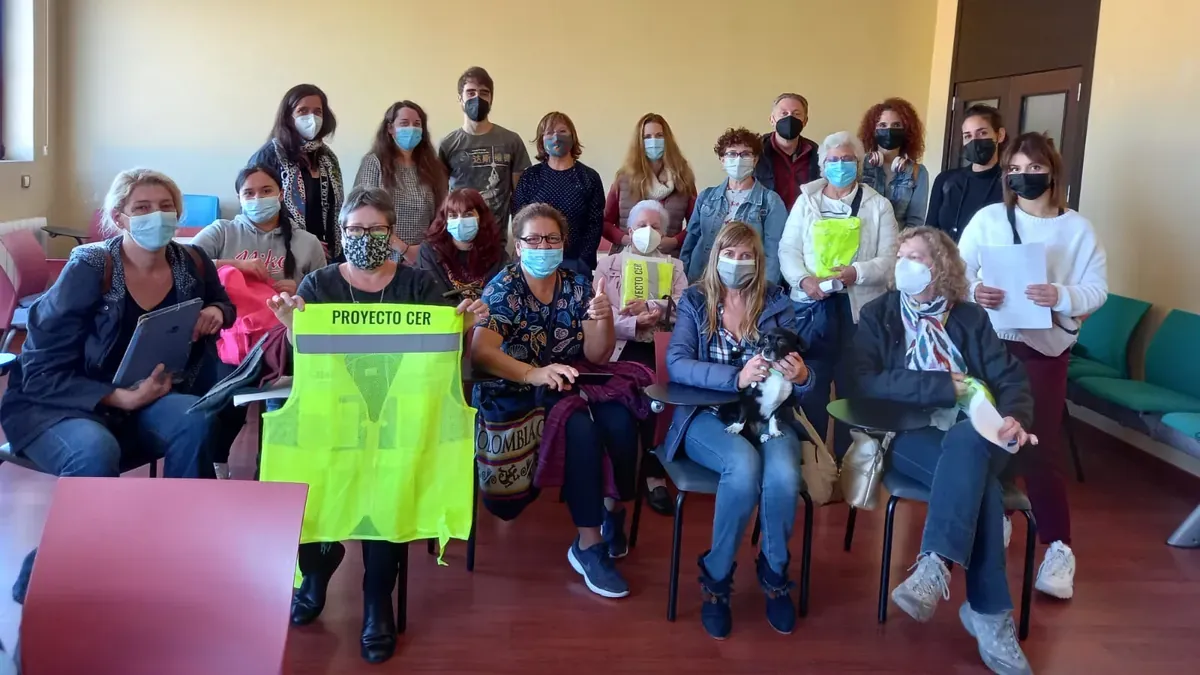
In short. A TNR (Trap-Neuter-Return) programme only works if the town council and the cat colony managers work together. Spain’s Law 7/2023 includes the «fomento de la colaboración ciudadana para el cuidado de los gatos comunitarios» (art. 39.1.a; quoted in Spanish from the BOE, which has no official English translation). Drawing on my experience as a volunteer, a councillor for Public Health and a co-founder of Meow Metrics, I explain what worries the mayor, the councillor and the municipal technician, and how volunteers can earn their trust: patience, practical help and professionalism.
Key ideas
- A town council has three figures with different concerns: the mayor, the councillor for the area and the municipal technician.
- Trust is built with three attitudes: patience, a willingness to help and professionalism.
- Cat colony managers do not just feed: they manage community cats with a knowledge of the street that nobody else in the municipality has.
- A municipal group of cat volunteers, like those of Civil Protection, could give managers recognition, training and the insurance provided for by the applicable volunteering law.
- Without collaboration there is no TNR: the council cannot do it alone, and neither can the volunteers.
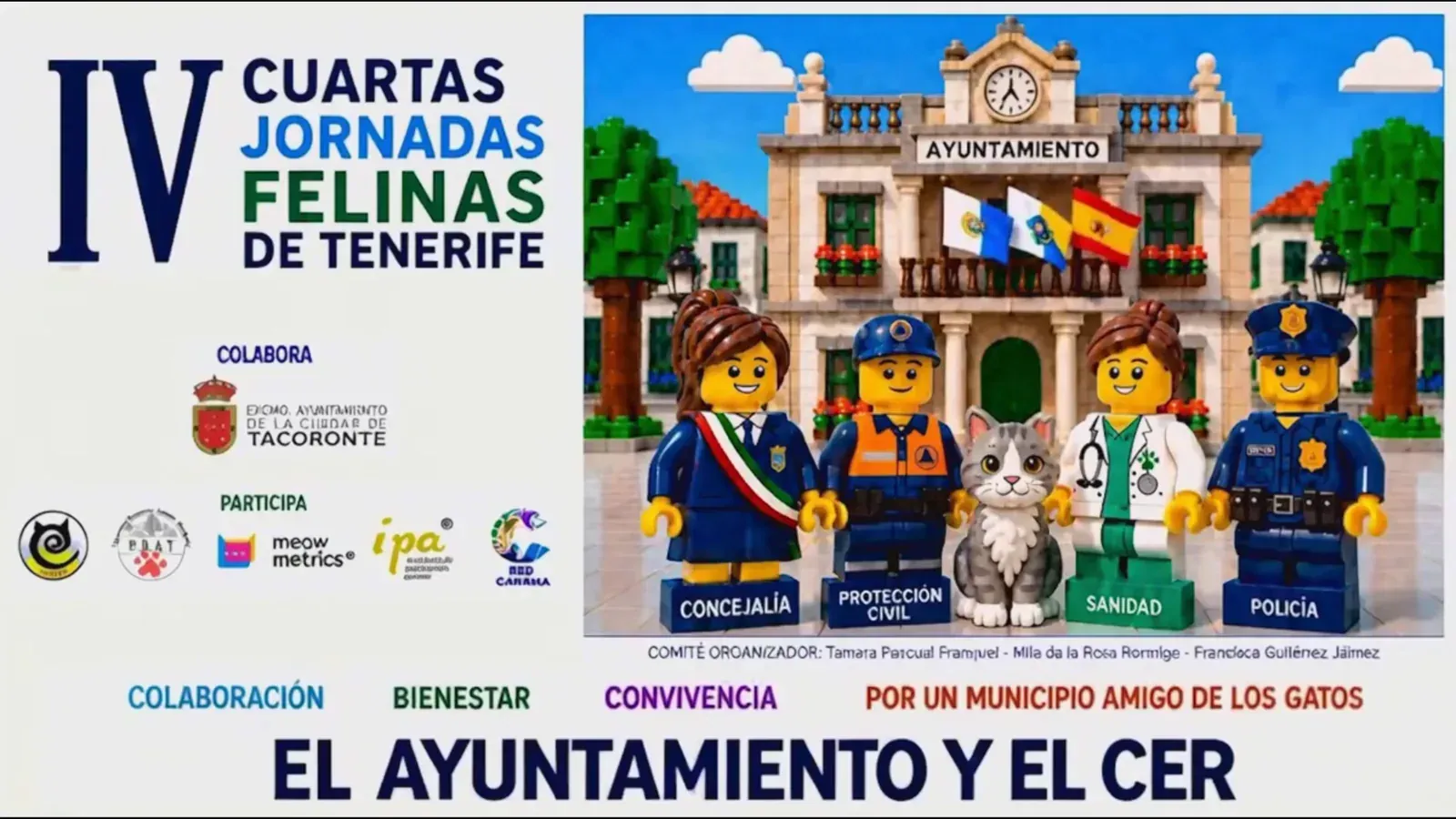
This article is based on the talk «CER desde el otro lado: cómo construir una relación de confianza entre Ayuntamiento y voluntariado» (in English, “TNR from the other side: how to build a relationship of trust between the council and volunteers”), which I gave at the 4th Tenerife Cat Conferences (Jornadas Felinas de Tenerife), held in Tacoronte (Tenerife, Canary Islands, Spain) on 20 and 21 November 2026 with the collaboration of the Animal Welfare Department of the Tacoronte Town Council (Ayuntamiento de Tacoronte) and the participation of organisations such as the Plataforma por el Bienestar Animal de Tacoronte (PBAT). According to its poster, under the theme “The Council and TNR” («El Ayuntamiento y el CER», in Spanish), the conferences brought together local government, volunteers and organisations around four ideas: collaboration, welfare, coexistence and a cat-friendly municipality. Meow Metrics took part alongside other organisations. You can read the full report on the conferences in our article on the 4th Tenerife Cat Conferences.
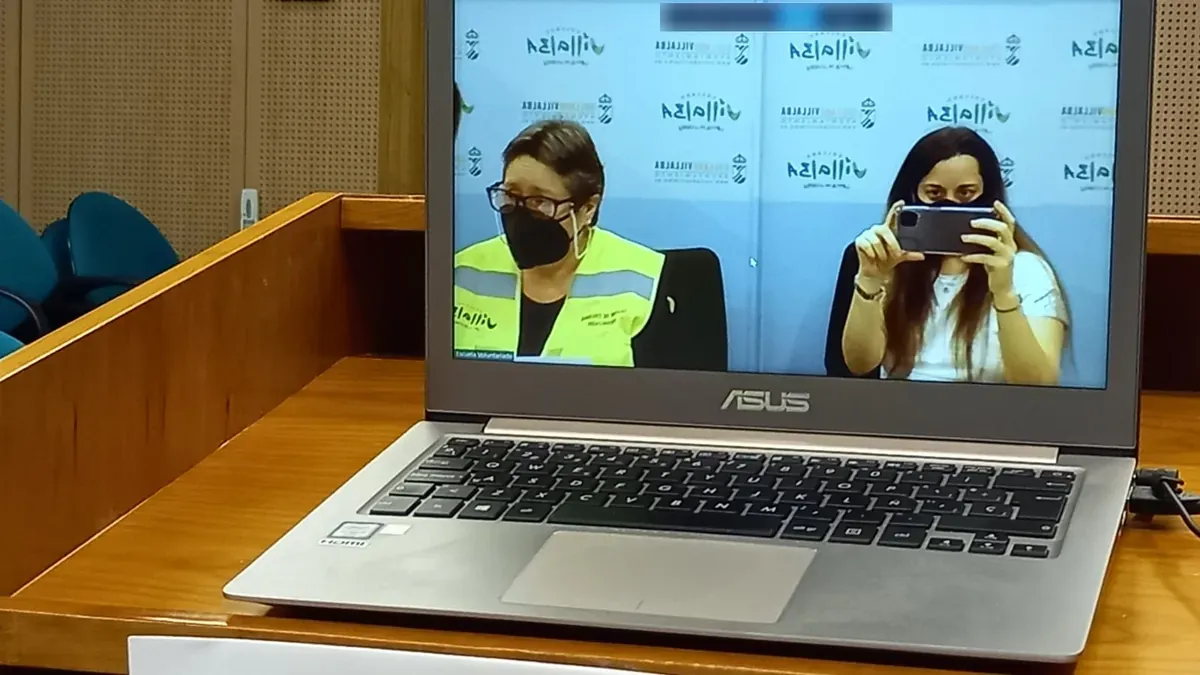
The Friday 20 November session was streamed live on the Tacoronte Town Council’s YouTube channel. You can watch the full talk on YouTube from minute 11:30 (in Spanish).
Jornadas Felinas de Tenerife 2026, Friday 20 November session: talk by Diana Barrantes (Tacoronte Town Council)
It is written for cat colony managers, animal protection associations and foundations, but also for councillors and technicians who want to understand what the people who manage their municipality’s community cats expect of them.
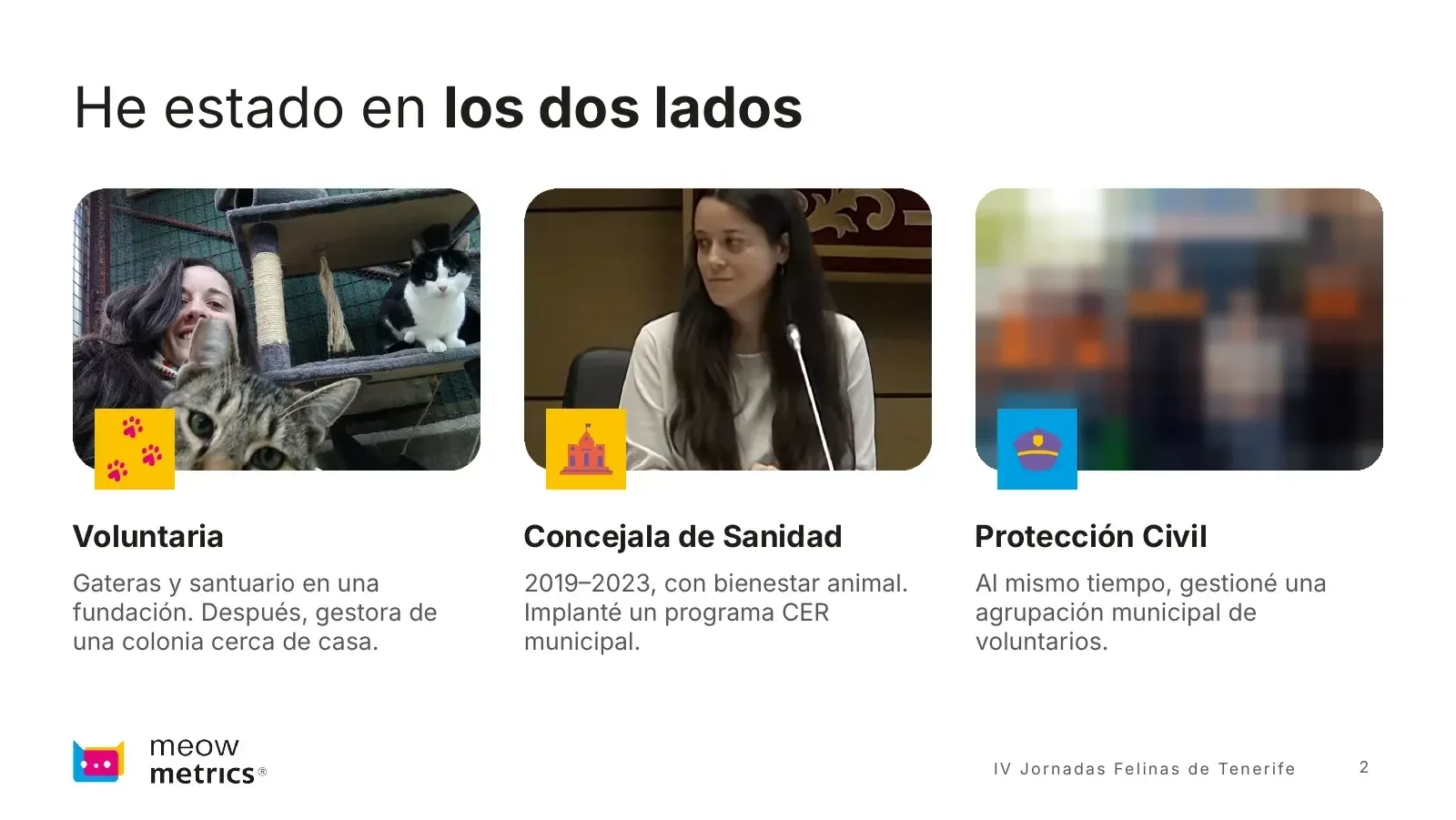
I have been on both sides of cat colony management
I started like many colony managers: as a volunteer. First at a foundation, looking after the cat enclosures and helping at its sanctuary. Then at a cat colony near my home, which I shared with other neighbours, without any institutional backing and paying out of our own pockets.
Later I moved into municipal politics. Between 2019 and 2023 I was councillor for Public Health at the Collado Villalba Town Council (Madrid, Spain), with responsibility for animal welfare, and I set up a municipal TNR programme from scratch, before there was a national law. At the same time I ran Civil Protection, so I also managed a group of volunteers from inside the council.
I have been the volunteer who asks, the councillor who has to answer and the public official who coordinates volunteers. Today, as a co-founder of Meow Metrics, I work every week with councils and associations that are trying to understand each other. That is why this article starts from a simple question: what is on the other side?
If you are just starting out, in how to set up a municipal TNR programme from scratch I explain where I began as a councillor.
Who is on the other side? The three key figures in the council
To build a relationship of trust with the council, you first need to know who you are talking to. I suggest an exercise: put ourselves in their shoes. What interests them? What worries them?
The mayor
The mayor leads a plan for the municipality over four years. They have to manage everything and do it as well as possible. And, as elections approach, they also want to be able to keep doing it. That is a legitimate aspiration, and it is worth bearing in mind.
The councillor for the area
Councillors have similar motivations, but grounded in the day-to-day of the areas assigned to them. They receive neighbours’ complaints constantly. And what they want least is fires, because when there is one they have to put it out in front of the press, the opposition and the neighbours.
The municipal technician
Together with the administrative staff who support them, technicians run the area in practice: paperwork, reports and bureaucracy. They usually have a lot of responsibility, a lot of work and little time. In most cases, they are the person who makes a TNR programme move forward (or not).
What worries each profile and what volunteers can offer
There are many kinds of mayors, councillors and technicians. But if we think about what worries each of them, it is easier to go from being seen as part of the problem to being part of the solution.
| Profile | What worries them | What volunteers can offer |
|---|---|---|
| Mayor | Public image and the plan for the municipality | Press releases with the TNR results, initiatives that neighbours welcome and visibility on social media |
| Councillor | Conflicts: complaints, press and opposition | Mediation with neighbours, spreading the word about the programme and warnings before a problem blows up |
| Municipal technician | Lack of time and not knowing where to start | Equipment checklists, reliable suppliers, colony censuses, well-written applications and grants identified for them |
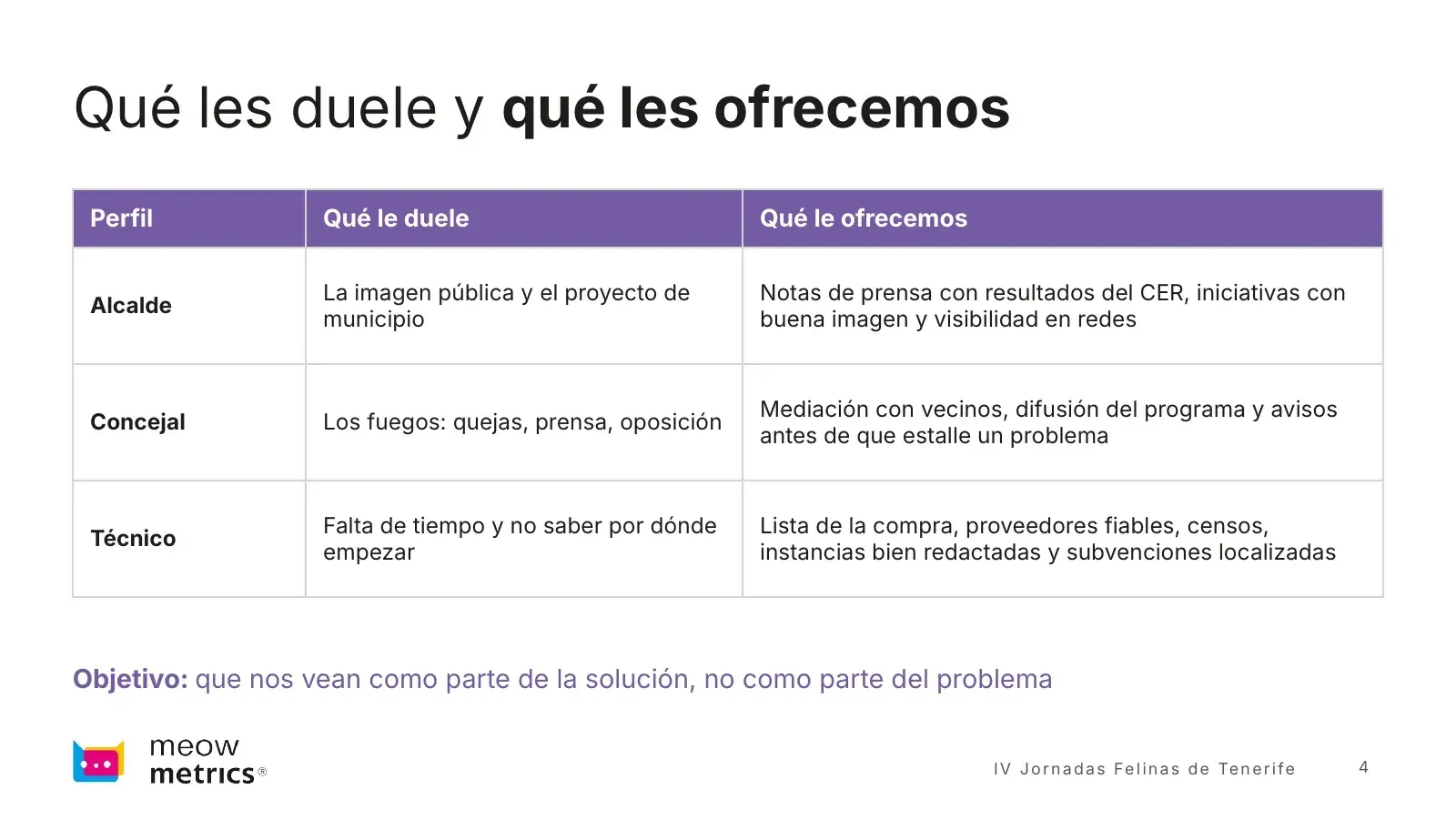 Thinking about what worries each profile turns volunteers into part of the solution.
Three keys to getting the council to trust cat volunteers
1. Patience, and understanding why administration is slow
I know that many of you managers have been waiting for answers for years. Even so, the first thing I ask of you is patience. Administration is slower than we would like, and it is almost never out of ill will:
- There is a lot of work and few staff. The same people deal with many other responsibilities.
- The budget is limited and has to be shared among many needs.
- There is no room for error. In a council, a mistake is a public problem. That is why they cannot afford experiments and are extremely cautious.
- TNR is a new and complex responsibility. It involves many people, variables and organisations. Many technicians are wonderful at processing files, but there is no reason for them to know how to manage groups of people.
Grants also take time: someone has to find them, write the application, submit it and wait for a decision.
2. Be an ally: trust is earned with small gestures
Patience alone is not enough. What a technician or a councillor values most is seeing the volunteer as an ally: someone who understands their situation and comes to add value. When that happens, they feel enormous relief.
That trust is built with simple gestures:
- “How can I help you?”
- “Look, I have found this grant.”
- “I’ll help you count the cats in this area.”
Trust does not come overnight. It is built step by step and together.
3. Professionalism: cat colony managers, not feeders
Many volunteers have spent years, some decades, caring for cat colonies with no backing, no recognition and, at times, with problems. We must not forget that: we have to learn from it. But now that the law backs them, it is time to show that volunteers are up to the task.
That is why at Meow Metrics we always, and deliberately, talk about cat colony managers and community cats. Calling them feeders reduces them to a single task, and their work is far broader. Spain’s Law 7/2023 speaks of «cuidadores de colonias felinas» (cat colony caregivers), a lovely term that we have no objection to. We prefer “managers” because they do care, yes, but through increasingly professional management. A colony manager:
- Knows each cat in her colony: she knows when one is missing and when a new one appears, and can raise the alarm over a loss or an abandonment.
- Spots signs of illness and injuries from falls, road accidents or fights, and knows when a cat has died.
- Traps the specific cat that needs it, takes it to the vet and gives it medication as prescribed. She also traps the last female left to be neutered.
- Keeps the area clean, including the rubbish that other people often leave, to avoid problems with neighbours.
- Talks to the neighbours, holds dialogue and, very often, acts as a diplomat.
We are volunteers, not employees, but cat volunteers are highly qualified. That professionalism includes good manners, respect and building bridges. It also includes earning respect, never in a hostile way, but by knowing the law, the local TNR protocol and the technical guidelines well. We go deeper into this role in colony managers are the first line of alert.
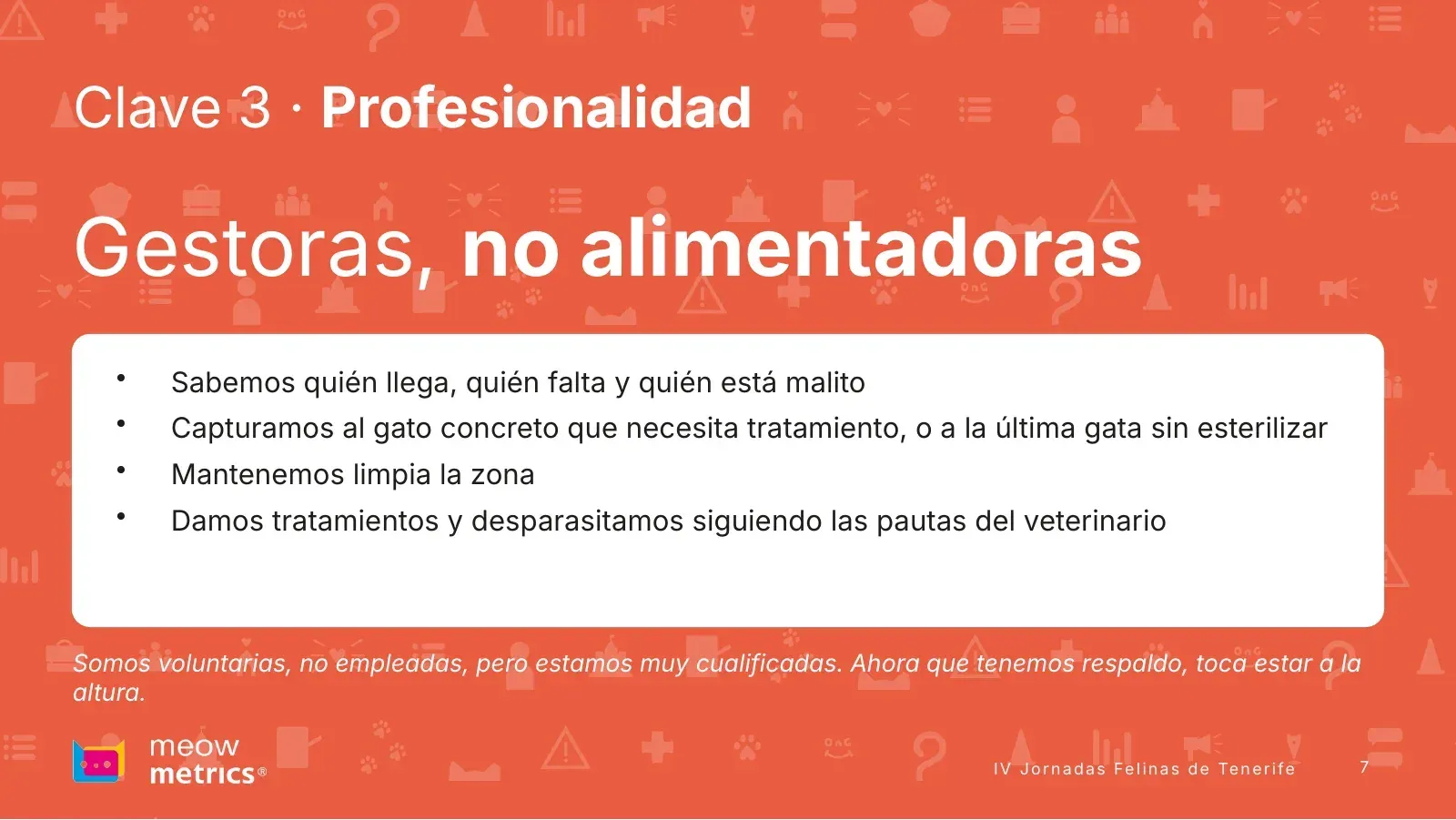 A colony manager does not just feed: she knows, traps, cares for and maintains the colony.
The street knowledge only community cat managers have
In a municipal TNR programme, three kinds of knowledge come into play, and none replaces the others:
- Vets are the highest authority in public health and veterinary care, but few know how to trap a cat.
- The council knows local rules and procedures, but not always the day-to-day.
- Colony managers know the street: each cat by name, when one is missing and which cat is shared between two colonies. They do not diagnose, but they know when a cat is unwell.
Colony managers also reach where the council does not: the building entrance, the residents’ association, the bar on the corner. They know how to be diplomatic and to mediate in a conflict before it becomes a formal complaint. For a councillor who wants to avoid fires, that is enormously valuable.
Practical ideas an association can offer its council
Not every volunteer can do everything. Each one contributes from her strengths, and it is not just a matter of asking for backing and resources, but also of bringing ideas:
- Relations with neighbours: explaining the TNR programme and mediating in conflicts.
- Trapping: the most experienced managers could form a local trapping team.
- Foster homes for kittens and animals in recovery.
- Social media: spreading adoptions and giving visibility to what the council does when it backs the programme.
- Good practice from other municipalities: the network of managers knows what works elsewhere. For example, turning disused glass-collection igloo containers into shelters for colonies: “if you give us one, we’ll adapt it and make it look lovely”.
- The shopping list: “What budget do we have? I’ll find you the most affordable and reliable suppliers of box traps and equipment”.
- Colony census: one of the most valuable offers. We explain how to carry out a cat colony census from the council.
- Public communication: proposing press releases on TNR results or new initiatives.
- Community initiatives: workshops in schools or a small colony looked after at a care home for older people.
The underlying idea is simple: “you give me your trust and I’ll help you”.
A proposal: municipal groups of cat volunteers
I go back to my experience in Civil Protection, which is organised into municipal groups of volunteers. Why not propose the same for cat volunteers?
A group of volunteers attached to the municipality would allow colony managers to be organised as volunteers, and not just as participants in the TNR programme. The national law, Spain’s Law 45/2015 of 14 October on Volunteering (Ley 45/2015, de 14 de octubre, de Voluntariado), applies to programmes «de ámbito estatal o supraautonómico», «sin perjuicio de las competencias atribuidas a las comunidades autónomas en materia de voluntariado» (art. 2.1, quoted in the original Spanish); for a municipal programme, it is worth checking the volunteering law of your autonomous community as well. For reference, among the rights of volunteers the national law includes the right to the following. It is quoted here in the original Spanish, from the BOE, which has no official English translation:
«Estar cubiertos, a cargo de la entidad de voluntariado, de los riesgos de accidente y enfermedad derivados directamente del ejercicio de la acción voluntaria y de responsabilidad civil en los casos en los que la legislación sectorial lo exija, a través de un seguro u otra garantía financiera.»
Such a group would mean:
- Formal recognition as municipal volunteers.
- Volunteer hours counted, so that the work is measurable and visible.
- Insurance, on the terms set by the applicable volunteering law.
- Ongoing training and regular refresher courses.
It is a way for the council to give something in return too, and to raise the recognition that cat volunteers deserve. In Collado Villalba we took steps in that direction: the managers received training with an exam and a municipal accreditation with an ID card, backed by a resolution of the Public Health Department (Concejalía de Sanidad).
Without collaboration there is no TNR: what article 39 of Spain’s Law 7/2023 says
It is frustrating to have to keep proving our worth, and there will be times when we do not manage it. But the law is on our side. Article 39 of Ley 7/2023, de 28 de marzo, de protección de los derechos y el bienestar de los animales (Spain’s Law 7/2023 of 28 March on the protection of the rights and welfare of animals; BOE-A-2023-7936) reads as follows. It is quoted here in the original Spanish, from the BOE, which has no official English translation:
«1. En ausencia de otra previsión en la legislación autonómica, y respetando el ámbito competencial establecido por la legislación vigente, corresponde a las entidades locales la gestión de los gatos comunitarios, a cuyos efectos deberán desarrollar Programas de Gestión de Colonias Felinas que incluirán, al menos, los siguientes aspectos:
a) Fomento de la colaboración ciudadana para el cuidado de los gatos comunitarios, regulando, a través de sus normativas municipales, los procedimientos en los que se recogerán derechos y obligaciones de los cuidadores de colonias felinas.»
(Spain’s Law 7/2023, art. 39.1 and 39.1.a, in the BOE, in Spanish)
That is why I repeat a mantra that everyone who works in TNR should have engraved on their mind: without collaboration there is no TNR. The council cannot do it alone, and the managers cannot do it alone. If they could, there would be no unmanaged cats on our streets. What else that programme must include is set out in cat colony management programme: what it should include and how to approve it.
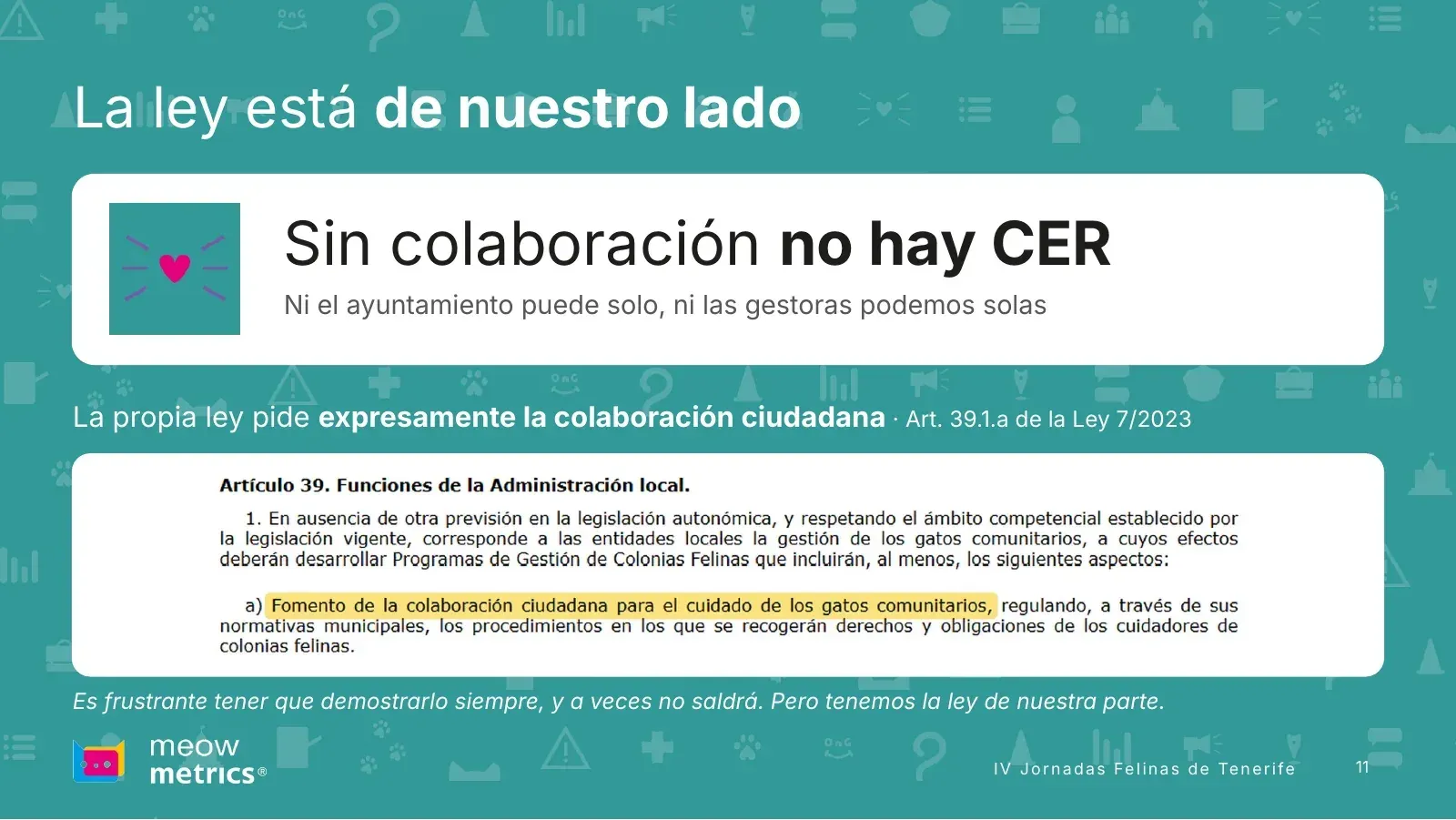 Slide from the talk with article 39.1.a of Spain’s Law 7/2023 (full text quoted above).
Behind the institutions there are people
It does not always work out. Behind every institution there are people, each with their own circumstances: some will make it easy for you and others less so. That is why I close with three messages:
- If you already have municipal officials who listen to you and back you, look after them well and work as a team.
- If you have not found them yet, do your part so that they see that working with you is the best thing for them and for the municipality.
- If the situation is difficult, remember that you have each other. Keep doing it well, with good manners, with respect and with patience.
The better we people are, the better the cats we look after will be. And there are reasons for hope: more and more municipalities across Spain are making progress in managing their cat colonies and community cats, thanks to the law and, above all, to the efforts of volunteers, associations and councils.
Keep reading
- 4th Tenerife Cat Conferences: the council and TNR under discussion in Tacoronte
- Community Cat Management Has Changed Forever in Spain
- Law 7/2023: The Future of Ethical Community Cat Management in Spain
From experience to technology: why we created Meow Metrics
Consolidating the TNR programme in Collado Villalba took me four years, with no digital tools and no national law to back us. We created the group of managers, appointed coordinators according to their strengths (trapping, census), approved a municipal TNR protocol and updated a responsible pet ownership by-law that had gone almost twenty years untouched.
From that experience Meow Metrics was born, the TNR and cat colony management app that we have developed at Zoometrics for councils, associations, foundations and volunteer managers. Our position is clear: Meow Metrics does not implement TNR. The council and its volunteers do. What the tool does is digitise it so that all parties work on the same data for each colony and each community cat, save time and give dignity to the work of volunteers. That is why it is free for associations: the licence is paid for by the council. And it does not stop at the software: we support each council and its volunteers in setting the programme up. If you want to know what a good tool should have, we explain it in cat colony app: 7 keys to effective municipal TNR management.
Today we serve municipalities of all sizes, from towns of 140 inhabitants to cities of more than 700,000, such as Zaragoza. In Yebes (Guadalajara), the councillor in charge consolidated their TNR programme in less than a year. It took me four.
Frequently asked questions
What is a TNR programme?
It is the trap-neuter-return method for managing cat colonies: community cats are trapped, neutered, identified and returned to their colony, where the managers look after them and keep track of them.
What does Spain’s Law 7/2023 say about collaboration with the people who look after colonies?
Article 39.1 of Spain’s Law 7/2023 lists the aspects that the Cat Colony Management Programmes «incluirán, al menos». The first, point a), is the «fomento de la colaboración ciudadana para el cuidado de los gatos comunitarios, regulando, a través de sus normativas municipales, los procedimientos en los que se recogerán derechos y obligaciones de los cuidadores de colonias felinas» (quoted in the original Spanish from the BOE, which has no official English translation).
Why do we talk about cat colony managers and not feeders?
Because they do not just feed: they manage the colonies. They know each community cat, spot illness, injuries, losses and abandonments, trap the cats that need it and take them to the vet, give treatments as prescribed by vets, keep the area clean and mediate with neighbours. At Meow Metrics we say “managers” to value volunteer work that is carried out thoroughly and professionally.
How can an association earn its council’s trust?
With patience towards the pace of administration, by offering practical help (censuses, suppliers, grants, mediation with neighbours) and by acting professionally: knowing the law, the local TNR protocol and the technical guidelines.
Is there an app to manage TNR between the council and volunteers?
Yes. Meow Metrics is a TNR and cat colony management app in which the council, associations and volunteer managers work on the same data: colonies, community cats, trapping, neutering and follow-up. Councils such as Getafe, Zaragoza and Yebes use it, and it is free for associations because the licence is paid for by the council.
Can cat volunteers have insurance?
It depends on the applicable volunteering law. The national law, Spain’s Law 45/2015 on Volunteering, which applies to programmes «de ámbito estatal o supraautonómico» (art. 2.1), includes among the rights of volunteers the right to «estar cubiertos, a cargo de la entidad de voluntariado, de los riesgos de accidente y enfermedad derivados directamente del ejercicio de la acción voluntaria y de responsabilidad civil en los casos en los que la legislación sectorial lo exija, a través de un seguro u otra garantía financiera» (art. 10.1.e; quoted in the original Spanish from the BOE, which has no official English translation). For a municipal programme, also check the volunteering law of your autonomous community.
About the author
Diana Barrantes Olías de Lima is Founder and COO of Zoometrics, the company that develops Meow Metrics. She was a volunteer cat colony manager and, between 2019 and 2023, councillor for Public Health at the Collado Villalba Town Council (Spain), where she set up a municipal TNR programme from scratch and coordinated the Civil Protection volunteer group. She is a political scientist.
And what do you think? What would your council need to see cat colony managers as allies? If you are a manager, a technician or a councillor, we would love to hear about your experience.